
Every parent wants the best start for their child. But when you start researching high-quality preschool program options, the marketing all sounds the same: “nurturing environment,” “love of learning,” “school readiness.” It can feel impossible to know what actually matters.
The good news? Early childhood researchers have spent decades studying this question. And the findings are clear. High-quality preschool is not about the number of hours your child spends in a classroom. It is about what happens inside those hours and who is leading them.
Here is what the research says, and how it shows up inside every Growing Brilliant live class.
1. Small Groups, Every Time
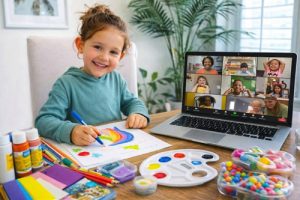
The single most consistent finding in early childhood education research is that group size matters more than almost anything else. Young children learn through relationships, through back-and-forth conversation, and through the experience of being truly seen by an adult who responds to them.
Decades of research from the National Institute for Early Education Research confirm that smaller group sizes are one of the strongest predictors of program quality. Dr. Robert Pianta at the University of Virginia found that what predicts child outcomes is not program type but the quality of teacher-child interactions, and those interactions are only possible when the group is small enough to make them happen.
At Growing Brilliant, small is not a selling point. It is a structural commitment. Our live classes are designed so that no child gets lost, no child raises their hand and waits indefinitely, and every teacher knows exactly who is in front of them.
2. A Teacher Who Actually Knows Your Child
The landmark report From Neurons to Neighborhoods, published by the National Academy of Sciences, identified the quality of early relationships as the single most important factor in healthy brain development during the first five years of life. Children do not learn from people they do not trust.
Every Growing Brilliant teacher is a highly-qualified Early Childhood Educator. They specialize in the developmental window between ages two and six, and they learn your child: their personality, their pace, what lights them up and what shuts them down. That knowledge does not reset every semester.
3. Sessions Built for How Young Children Actually Learn
Research on early childhood attention and cognitive load consistently shows that sustained, meaningful engagement in young children peaks within focused, time-limited windows. Beyond that window, fatigue sets in, retention drops, and what looks like learning is often just compliance.
This is exactly why Growing Brilliant live classes are 45 minutes.
Not because we run out of material. Because 45 minutes is the cognitive sweet spot for this age group. Long enough for deep, meaningful learning. Short enough that every child stays genuinely present from the first minute to the last. A two-hour session does not give a four-year-old more learning. It gives them more time to disengage.
The 45-minute design is not a compromise. It is the point.
4. Screen Time That Teaches, Not Just Entertains
Many parents hear “virtual learning” and picture a child parked in front of a screen, passively watching content scroll by. That concern is valid. But the research makes a critical distinction that most screen time conversations miss entirely.
The American Academy of Pediatrics has moved away from blanket time limits toward a focus on the quality and context of the experience. Passive viewing is where the developmental concerns live. Interactive, socially engaged digital learning with a present teacher is a fundamentally different category.
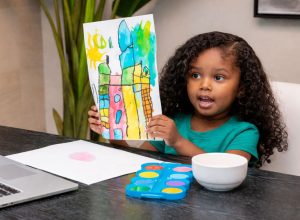
Dr. Kathy Hirsh-Pasek and colleagues at Temple University identified three criteria for high-quality digital learning: the experience must respond to the child, stay focused and free from distraction, and connect to the real world. Every Growing Brilliant live class meets all three. A child is not watching a video. They are in a live class with a real teacher who sees them, calls on them, and adjusts instruction in real time. The screen is the window into the classroom, not the content itself.
5. What a High-Quality Preschool Program Teaches: The Whole Child
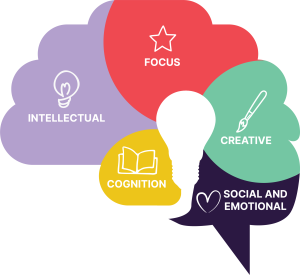
A high-quality preschool program builds a whole child across every developmental domain. The research is unambiguous: academic skills alone do not predict long-term success. The children who thrive are those who develop knowledge alongside the social-emotional and executive function skills that allow them to use what they know.
Academic Development
Growing Brilliant live classes span 65 or more subjects across literacy, math, science, music, art, and more. A child exploring science is building vocabulary. A child learning rhythm is developing mathematical thinking. This is not enrichment. It is how early learning is supposed to work.
Social-Emotional Learning
A landmark meta-analysis by Durlak and colleagues found that children who receive explicit social-emotional learning show measurable gains in academic achievement and long-term wellbeing. At this age, social-emotional development is not a sidebar to academics. It is the foundation underneath them.
Executive Function
The Center on the Developing Child at Harvard identifies the early childhood years as the most critical window for building attention, working memory, and impulse control. These skills are best developed through structured play and back-and-forth interaction, which is exactly how every Growing Brilliant live class is designed.
6. Ongoing Assessment So You Always Know Where Your Child Stands
The National Association for the Education of Young Children (NAEYC) identifies ongoing, authentic assessment as a core standard of quality early childhood programs. It should be continuous, observational, and directly tied to instruction, not a one-time test at kindergarten entry.
At Growing Brilliant, we have developed a proprietary assessment. You will not walk into a kindergarten screening wondering whether your child is ready. You will already know exactly where they stand, what they have mastered, and what comes next.
The Bottom Line
A high-quality preschool program is not measured in hours. It is measured in the depth of teacher-child relationships, the intentionality of session design, the breadth of curriculum across academic, social-emotional, and executive function domains, and whether someone is genuinely tracking your child’s progress.
Growing Brilliant was built around every one of these markers. Not because they make for good marketing. Because they are what the research says children need.
If you want to see what this looks like inside a real live class, we would love to show you.
Growing Brilliant is a live virtual preschool program for children ages 2 to 6, taught by highly qualified ECE teachers. We are Preschool for the Modern Family.

Frequently Asked Questions About High-Quality Preschool Programs
What makes a preschool program high quality?
A high-quality preschool program is defined by five research-backed markers: small group sizes that allow for real teacher-child interaction, a credentialed teacher with early childhood expertise, sessions designed for how young children actually learn, a curriculum that develops the whole child across academic, social-emotional, and executive function domains, and ongoing assessment that tracks each child’s progress throughout the program.
Is 45 minutes enough time for preschool?
Yes, and for children ages two to six, it is often the ideal amount of time. Research on early childhood attention and cognitive load shows that young children reach peak engagement and retention within focused, time-limited sessions. Beyond that window, fatigue sets in and learning diminishes. A well-designed 45-minute live class delivers more genuine learning than a longer session where a child has mentally checked out.
Is virtual preschool as effective as in-person preschool?
When virtual preschool includes a live teacher, a small group, real-time interaction, and hands-on activity, research supports it as a high-quality learning experience. The American Academy of Pediatrics distinguishes between passive screen time and interactive, socially contingent digital learning. A live virtual class where a teacher responds to your child in real time meets the same quality criteria as an in-person program.
What is the right screen time for a 4-year-old?
The American Academy of Pediatrics has shifted its guidance away from strict time limits toward focusing on the quality and context of screen use. Interactive experiences with a responsive adult, like a live virtual class, are developmentally different from passive viewing. The question to ask is not how long, but whether the experience involves a real person responding to your child and connecting to hands-on, real-world activity.
What is executive function and why does it matter in preschool?
Executive function refers to the mental skills that allow children to focus attention, hold information in working memory, regulate their impulses, and shift between tasks. The Harvard Center on the Developing Child identifies the early childhood years as the most critical window for building these capacities. Children with stronger executive function skills enter kindergarten better prepared to listen, follow directions, persist through challenges, and manage their emotions, all of which directly support academic success.
How do I know if my child is ready for preschool?
Readiness is less about what a child already knows and more about their ability to engage in a structured experience with a caring adult. If your child is curious, responsive to conversation, and able to participate in a short activity, they are ready. High-quality preschool programs are designed to meet children where they are, not where a checklist says they should be.
What is the difference between academic learning and social-emotional learning in preschool?
Academic learning covers literacy, math, science, and content knowledge. Social-emotional learning covers self-awareness, empathy, relationship skills, and the ability to manage emotions and make responsible decisions. Research from CASEL confirms that children who develop both simultaneously show stronger long-term outcomes than those who receive academic instruction alone. In high-quality early childhood programs, the two are not separated. They happen together in every session.